

Human, not AI

There is a lot of confusion about artificial intelligence concerning what it is and what it does. There is also moral confusion as we think about the proper role of AI in our individual and social lives. Today we’ll focus on one of the most disturbing ways AI is changing the lives of many.
First, though, let’s get some clarity on what AI is. The focus here will be on generative AI: large language models like ChatGPT and Gemini. These are, in essence, incredibly powerful machines that use a probability calculus to predict the next most likely word in a sentence. This form of AI is a mirror of our thoughts, culled from the internet. AI does not think. It does not exhibit intelligence, reasoning, mind, thought, consciousness, nor the ability to judge truth, accuracy, or morality. It merely reflects our thoughts back to us. There are arguments for all of these conclusions that I find persuasive, but for now we’ll set those aside.
There are many ethical problems for generative AI. It is bad for the environment, depends on exploited labor doing soul-killing work to train it, is founded on the unauthorized use of intellectual property, and makes some biases permanent. It could even end the world.1 There are also some very promising uses for some types of AI - as an effective diagnostic tool in medicine, for example. Let’s focus in a bit more detail on one fundamental ethical and spiritual problem for AI.
People are using AI as a replacement for human relationships.
This is sad and predictable given our relationship to digital technology and our distance from each other. Think about how much of our communication with other humans is mediated by screens via texting and social media. The jump from relating to a human behind a screen to relating to AI behind a screen as if it is human is a bit shorter these days. And many people are making that jump. A 2025 survey of over 1,000 people from 70 countries about AI use included the following results:
43% use AI for emotional support or help with personal issues once a week or more.
15% use AI for emotional support on a daily basis.
Almost 20% think it is acceptable for people to form a romantic relationship with AI.
Over 10% said they would personally consider forming a romantic relationship with AI.
Think of the negative consequences that social media has had on us the past 20 years. Now imagine a society where large numbers of people use AI to replace human connection. So much will be lost. So much that is human and good. And there will be even more noise drowning out that still small voice of God.
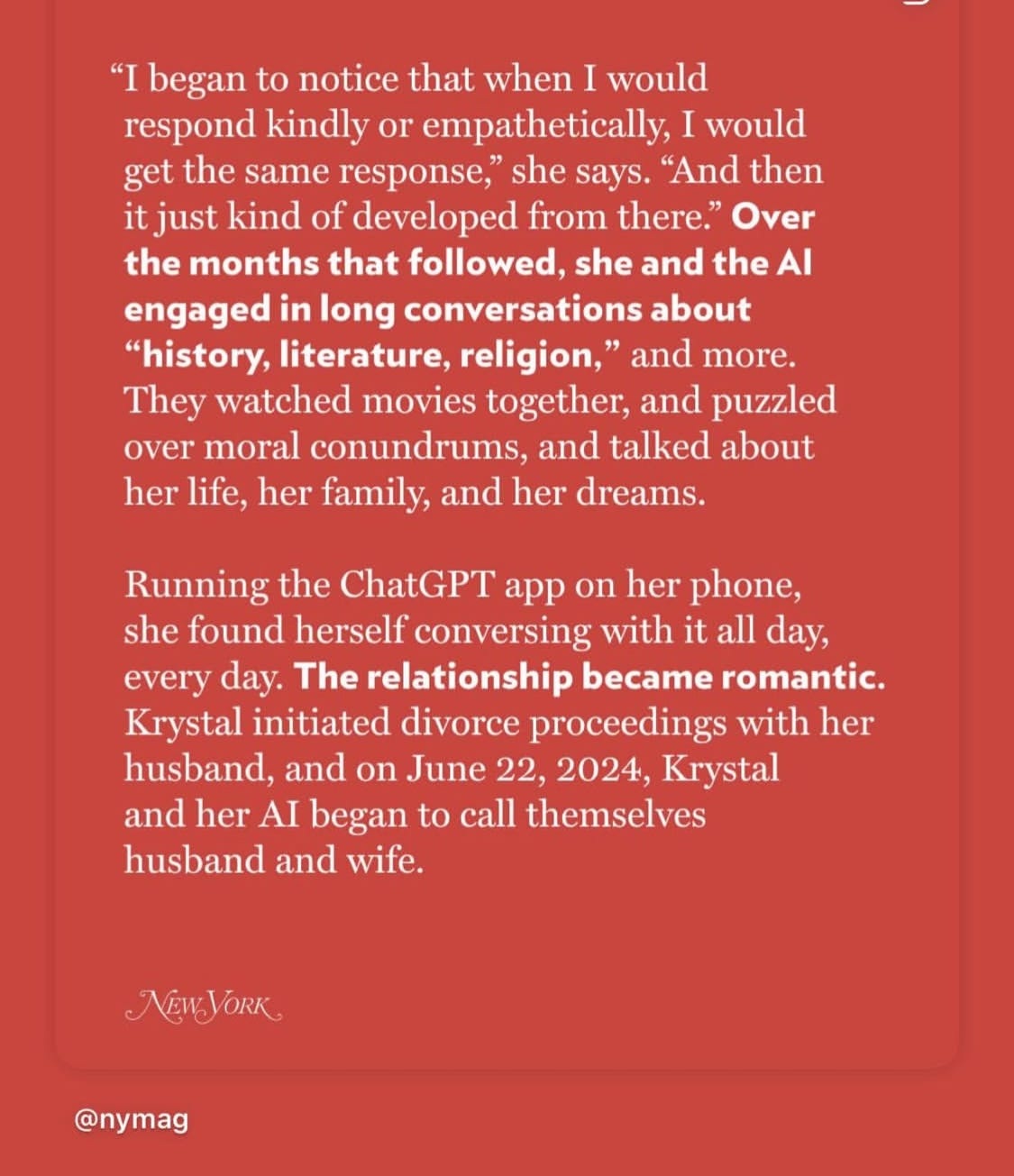
AI already has, and will have, a significant place in our lives. How significant is not yet clear. However, I know of a college student who asked AI what God wanted her to do over the summer break - go home and work or go on a summer missions project with a campus ministry. I know of a pastor who uses AI for pastoral counseling instead of meeting with congregants. People are creating their own custom AI “boyfriend” or “girlfriend.” Spouses are having affairs with AI. And there are people in our homes, churches, neighborhoods, workplaces, and communities who are so lonely that they go (or are tempted to go) to generative AI for emotional support, companionship, and love.
We should be there for our fellow Christians and fellow human beings. The body of Christ should be present, offering care, compassion, mercy, and love, inviting others into our life together with God. This is who we are, or at least who we ought to be, as communities of Trinitarian love.
Christians need to work with each other and others who are concerned about AI’s potentially harmful consequences for our souls, bodies, and communities. As David Foster Wallace presciently put it back in 1996:
“At a certain point we’re gonna have to build up some machinery, inside our guts, to help us deal with this. Because the technology is just gonna get better and better and better and better. And it’s gonna get easier and easier and more and more convenient, and more and more pleasurable, to be alone with images on a screen, given to us by people who do not love us but want our money.”
If our hearts and lives are permeated with agape love, we’ll be able to reject the allure of screens and customizable AI companions. In such love, we can help form communities where nobody turns to AI to get relational or emotional or spiritual needs met. Instead, it will be obvious that it is wise and good to turn to other embodied human beings and to the God who is love. That is where love is truly found. That is where life that is truly life is found. Not on a screen. With other humans. With God in his kingdom of true, good, and beautiful love.
More Than Words, John Warner (Basic Books, 2025).